

In mid-January the second most popular motorcycle racing series in the world took a step in a radical new direction. Monster Energy AMA Supercross – a seventeen round spectacle run in NFL and Major League Baseball stadiums across the USA in eighteen weeks and averaging almost 50,000 attendance each Saturday night – experimented with a ‘Triple Crown’ format and three ‘Main Event’ races in the Angel Stadium, Anaheim less than an hour east of Los Angeles.
Promoters and organisers Feld Motorsport wanted to trial an facet of the annual Las Vegas-set Monster Energy Cup inside the high profile championship and give fans in the seats, those through live TV broadcaster Fox Sports 1 and the thousands of international followers via the online App triple-whammy for their buck.
There was a general feeling of open-mindedness in the veer away from the usual, sole twenty-minute and one lap Main Event, and the most sizeable shift to the sport since establishment of the Supercross contest in 1974. The riders commented on a slight more hectic night programme but there was an immediate buzz in the stands once the glitz and glamour of the opening ceremony dropped away and the lights pinged to full brightness on the temporary track mounted on the A’s infield. Athletes lined up in the gate and the serious business of racing got underway instantaneously with the formalities of practice and qualification having already taken place in the afternoon.
As ever with Supercross, the action was intense and at ‘A2’ Monster Energy Kawasaki’s Eli Tomac was able to seize his first overall victory after proving to be the strongest through the three dashes.
The Triple Crown will appear at Atlanta and Minneapolis (rounds nine and fourteen in March and April) before facing a review at the end of the campaign with the finale once more scheduled for Vegas in May.
In a search for further perspective on the current status quo of Supercross it made sense to seek out the ‘King’ of the discipline. With 85 wins and 8 titles the name ‘Jeremy McGrath’ is one that elevated from the realms of supercross to define the sport as a whole. McGrath was a star, a showman, a tour de force of competition and a visible face for the panache and style that went hand-in-hand with dirt bike racing in the 1990s. Thanks to a humility and an endearing way with people, McGrath is still hot property in motorcycling circles and a desirable figurehead for brands like Kawasaki and Monster Energy; as a motorcycling and motorsport athlete they rarely get any bigger.
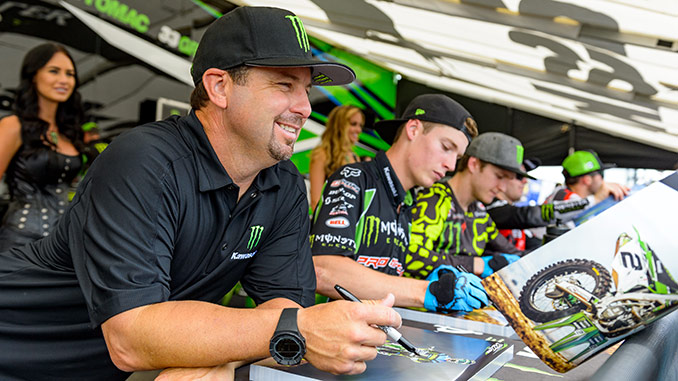
Finding Jeremy is not the hard part of securing his time at a Supercross fixture; he is typically hovering around the Kawasaki Racing Team truck. Making sure you can sit down and talk is another matter. Thankfully at Anaheim we procure the necessary ten-minute conversation with the 46 year old who still looks remarkably trim and is regularly in the saddle.

Jeremy, how do you feel about Supercross in 2018? Does it need a makeover?
You know, I’ve been in this my whole life and when the gate is about to drop I’m still like a little kid; I’m still passionate about it. I don’t necessarily feel that you need to be a motorcycle fan to enjoy this show. Competition is alive and well, and on a selfish side I guess I’d like to see a bit more personality from these guys but sometimes competition breeds seriousness; know what I mean? This is a real sport, real job and these guys are athletes. We live in a world where everything has to change, and change fast-and-now. Everyone is bored after a minute. When we were young it was different and it seems that people’s attention span now is so short. It is always ‘what’s the next thing?’ and unfortunately sports get hit with that too. I’m excited for the format change – I think it’s awesome. Do I think it needs a change? I’m not sure. I think Supercross on the whole is a tried-and-true formula that works…although it’s exciting to mix it up a little bit.
Is something like motocross – with its traditional four moto format and all-day commitment – quite a dinosaur in comparison?
They have been saying that motocross is a dying format for years but it keeps going. I think motocross is something that people can relate to. That’s why Supercross is such a big show right? People come here to see and watch something they cannot do. This is a spectacle. Not everyone can ride a track like this or make a motorcycle do these kinds of things.
You mention personality of the riders…but that must be both harder and easier to craft properly with social media now. In your prime there were photoshoots and videos but mostly people only saw you at the race…
Yeah, social media is a place where you can show off…but it is also a place where you can make your deals and your money. In one sense you almost become a ‘victim’ of having to do that stuff but it shows that you can also make something of yourself and that there are many different ways of doing that. Of course you have to work hard and there is no easy way [to make it] but it shows that it’s possible. Some of it is fake…you can make yourself look bigger than you are! But that is also marketing 101 right? As I’ve always said: there is a fine line between arrogance and confidence. Of course it is a lot different now and when we were young we kinda had to let the Saturday night race speak for us; we didn’t have that platform.

Is Supercross seen as ‘too American’? Is it curious why this series never really went international. You raced in Europe and Japan so you know there is an audience for it on a worldwide scale…
Some might say that about NASCAR too and Supercross could fall into that category. You have to wonder why it never went international…I guess it’s because Feld have mainly covered the US and a bit in Canada. About 10-15 years ago there was a World Supercross attempt but I know the riders didn’t like that. Supercross starts here, and in January.
Coming back to the format: is there a danger that too much change complicates things? You see that with technical rule alterations in F1, NASCAR, MotoGP over the years…
I like what they do in NASCAR to try and make everyone even, and that’s what sorta-makes-it-good. You really don’t know who is going to win and it rotates around a lot. Supercross still seems to be about the athlete and a bike and there is a lot to be said for that. It’s pretty untouched.
Lastly do you still feel connected to this sport? In many people’s eyes you are the definition of Supercross. Does it sometimes feel strange to be held in this regard…?
It does feel like a different lifetime but when the races happen I am on the gate with those guys and I’m having those same feelings because I know what it takes, and I have been there and done it. I know what it’s like to have a holeshot or a fall because I have been in those same positions. The reason I love the sport is that I still love riding my dirt bike. It has provided me with a life that I could never have imagined. In one way it seems weird to me to hear that or say it of myself [his legendary status] because I never look at it that way but I guess it explains why I can still work in the industry and it’s through the relationships I have built. I’ve been a good ambassador for the sport and I’m not sure if all the past champions can say that. I’m just doing what I love and I am not trying too hard to be something. I think it is easy to see that I like what I do and it’s pretty transparent.
Thanks and handshakes made, McGrath finishes the rest of a chocolate energy bar he’d been devouring and heads out of the KRT awning to be greeted by more fans; some older and some who hadn’t been born when he completed his last races in 2002.
That evening the Triple Crown would fire six races at the Angel Stadium public and was a success in terms of sustaining the drama and rapid-fire exhilaration of Supercross. McGrath must have been feeling every landing and pulse-racing gatedrop. Where the sport heads in 2019 will be fascinating to chart. The Monster Energy Cup is the vanguard for other potential ‘tweaks’ to Supercross such as an obligatory ‘Joker Lane’ and an inclined split Start and could become a useful prognosticator in years-to-come as Feld look to keep the package of the sport as desirable and digestive as possible. One thing’s for sure: Jeremy McGrath will still be watching.